Christopher Winter Jr.
Click here to return to the leighlarson.com Home Page.
Click here to go the Genealogy Page.
Christopher Winter Jr. was born April 10, 1740, in Uxbridge, Worcester Co., MA, and died 1837, in Haldimand Twp., District of Newcastle, Province of Upper Canada, at about age 97. He is the son of Christopher Winter Sr. of Mendon, Worcester Co., MA, and Ruth Aldrich, of Mendon, Worcester Co., MA. Christopher Winter could not read or write..
Zeruiah Smith was born November 7, 1741, in Pomfret, Windham Co., CT, and died 1816, in Haldimand Twp., District of Newcastle, Province of Upper Canada, at about age 75.
Christopher Winter Jr. and Zeruiah Smith, of Salisbury, were married by Rev. Jonathan Lee, October 22, 1767, in Salisbury, Litchfield Co., CT. Zeruiah Smith may be the daughter of John Smith and Mehitabel Adams. Their son, John Winter, was born August 13, 1768, in Salisbury, Litchfield Co., CT. Their daughter, Zeruiah Winter, was born June 12, 1770, in Salisbury, Litchfield Co., CT.
Christopher Winter Jr. and Zeruiah (Smith) Winter had six or seven children:
- John Winter: Born August 13, 1768, in Salisbury, Litchfield Co., CT; Died October 29, 1847, in Henry Co., IL (age 79). Buried in Saxon Cemetery, Henry Co., IL. Married September 1, 1792, in West Stockbridge, Berkshire Co., MA, to Zeruiah Fuller: Born May 24, 1774, in Sharon, Litchfield Co., CT; Died January 20, 1854, in Stark Co., IL (age 75). Buried in Saxon Cemetery, Henry Co., IL. She is a Mayflower descendant of Edward Fuller (1575 - 1621).
- Zeuriah Winter: Born June 12, 1770, in Salisbury, Litchfield Co., CT; Died October 25, 1847, in New Lisbon, Otsego Co., NY (age 77). Buried in Lena Cemetery, New Lisbon, Otsego Co., NY. Married to William Tuller: Born December 13, 1763, in Simsbury, Hartford Co., CT; Died April 16, 1840, in Otsego Co., NY (age 66). Buried in Lena Cemetery, New Lisbon, Otsego Co., NY.
- Rebecca Winter: Born March 30, 1772, in Uxbridge, Worcester Co., MA; Died Unknown. Married 1865, in Unknown, to Jonathan L. Ross: Born 1797, in Unknown; Died 1874, in Unknown (about age 77).
- Mary "Polly" Winter: Born April 11, 1777, in Fishkill, Dutchess Co., Province of New York, and died March 29, 1869, at the home of her daughter, Lurenda (Abbey) Henry, Port Oshawa, Whitby East Twp., Durham Co., Ontario, Canada, at age 92. Buried Pioneer Cemetery, Whitby East Twp, Durham Co., Ontario, Canada. Married about 1795, in Dutchess Co., NY, to Nathaniel Abner Abbey Sr.: Born about 1775, in Dutchess Co., Province of New York; Died 1825 in Hope Twp., Durham Co., Upper Canada (about age 50).
- James Winter: Born November 26, 1780, in Vermont; Died March 23, 1836, in Grafton, Northumberland Co., Ontario, Canada (about age 55). Buried in Fairview Cemetery (Stanley Cemetery), Married before 1805, in Unknown, to Huldah Hinman: Born July 8, 1788, in Clarendon, Rutland Col., VT; Died April 23, 1832, IN Haldimand Twp., Northumberland Co., Upper Canada (age 44). Buried in Fairview Cemetery (Stanley Cemetery), Haldimand Twp., Northumberland Co., Upper Canada.
- Lewis Winter: Born June 1, 1782, in Salisbury, Litchfield Co., CT; Died 1861, in Haldimand Twp., Northumberland Co., Canada West (about age 79). Married (1) 1802, in Unknown, to Jerusha Crandall: Born June 17, 1784, in the USA; Died Unknown. Married (2)
- Paddick Vadoch Winter: Born September 2, 1787, in Dutchess Co., NY; Died May 18, 1861, in Haldimand Twp., Northumberland Co., Canada West (age 73). Buried in Academy Hill Cemetery (Massey Cemetery), Centreton, Northumberland Co., Ontario, Canada. Married (1) about 1814, in Haldimand Twp., Northumberland Co., Upper Canada, to Deborah Unknown: Born January 16, 1797, in the USA; Died March 27, 1823, in Haldimand Twp., Northumberland Co., Canada West (age 26). Buried in Academy Hill Cemetery (Massey Cemetery), Centreton, Northumberland Co., Ontario,, Canada. Married (2) after 1823, to Susannah Unknown: Born September 10, 1798, in Ireland; Died August 26, 1855, in Haldimand Twp., Northumberland Co., Canada West (age 56). Buried in Academy Hill Cemetery (Massey Cemetery), Centreton, Northumberland Co., Ontario, Canada.
After Zeruiah (Smith) Winter died, Christopher Winter married Anne "Annie" (Hawley) Scott.
Aaron Scott was born December 10, 1734, in Waterbury, New Haven Co., CT, and died 1807, in Madrid, Saint Lawrence Co., NY, at about age 72. He is the son of Jonathan Scott of Ireland, and Lydia Thwing of Cambridge, MA.
Anne "Annie" Hawley was born September 25, 1748, in New Milford, Litchfield Co., CT, and died November 14, 1846, in Colborne, Cramahe Twp., Northumberland Co., Ontario, Canada, at age 98. She is the daughter of Ephraim Hawley Sr. and Ann Chapman, and the twin of Ephraim Hawley Jr.
Aaron Scott and Anne "Annie" Hawley were married about 1764, in Pennsylvania Twp., Somerset Co., PA.
Aaron Scott Sr. and Anne "Annie" (Hawley) Scott had ten sons and four daughters:
- Aaron T. Scott Jr.: Born 1772, in Tennessee; Died 1862, in Saluda, Jefferson Co., IN (about age 90). Married about 1817, in Kentucky, to Anna Aja Agee: Born 1796, in Franklin Co., VA; Died October 14, 1853, in Saluda, Jefferson Co., IN (about age 57).
- Asahel Scott: Born March 7, 1778, in Cornwall, Addison Co., VT; Died after 1852, in Pickering, Ontario, Canada. Married Unknown, to Lydia Watrous: Born March 3, 1778, in Connecticut; Died January 10, 1870, in Lexington, Sanilac Co., MI (age 81). Buried in Carman Cemetery, in Lexington, Sanilac Co., MI.
- Ichabod Hawley Scott: Born March 17, 1780, in Cornwall, Addison Co., VT; Died December 5, 1867, in Madrid, Saint Lawrence Co., NY (age 87). Buried in Union Cemetery, Waddington, Saint Lawrence Co., NY. Married about 1807, to Sarah Runnels: Born 1781, in Connecticut; Died December 4, 1863, in Waddington, Saint Lawrence Co., NY (age 82). Buried in Union Cemetery, Waddington, Saint Lawrence Co., NY.
- Phoebe Scott: Born February 2, 1782, in Cornwall, Addison Co., VT; Died Unknown.
- Ephraim Scott: Born July 24, 1784, in Cornwall, Addison Co., VT; Died Unknown,, in Pickering, Ontario, Canada.
- Alma Scott: Born August 9, 1786, in Cornwall, Addison Co., VT; Died Unknown.
- Amos Scott: Born August 9, 1788, in Cornwall, Addison Co., VT; Died April 10, 1872, in Bristol, Addison Co., VT (age 83).
- Abel Scott: Born July 9, 1790, in Cornwall, Addison Co., VT; Died Unknown.
- Reuben Scott: Born April 10, 1792, in Cornwall, Addison Co., VT; Died December 9, 1872, in Colborne, Cramahe Twp., Northumberland Co, Ontario, Canada (age 80). Buried in East Colborne Cemetery, Colborne, Northumberland Co, Ontario, Canada. Married Unknown, to Sarah Louise Keeler: Born 1795, in Vermont; Died July 8, 1864, in Canada (about age 69). Buried in East Colborne Cemetery, Colborne, Northumberland Co, Ontario, Canada.
- Betsey Scott: Born October 11, 1793, in Cornwall, Addison Co., VT; Died Unknown.
- Anna Scott: Born January 18, 1795, in Cornwall, Addison Co., VT; Died 1862, in Unknown (about age 67). Married 1810, in Unknown, to James Webb: Born February 1, 1783, in Windham, Windham Co., CT; Died October 3, 1841, in Utica, Oneida Co., NY (age 58).
- Unknown Scott:
- Unknown Scott:
- Unknown Scott:
Christopher Winter Jr. and Anne (Hawley) Scott were married 1817, in Northumberland Co., Upper Canada.
Christopher Winter Jr. and Anne (Hawley) (Scott) Winter had no children.
TIMELINE
Ontario was known as: "Upper Canada" from December 26, 1791, to February 10, 1841; "Canada West" from February 10, 1841, to July 1, 1867; and "Ontario" after July 1, 1867.
It is surmised that Nathaniel Abner Abbey Sr. (age 22), and his wife Mary "Polly" (Winter) Abbey (age 21), and
their two children, Rosana Abbey (about age 2), and Isaac Phineas Abbey (about age 1), came to Haldimand Twp., Northumberland Co., Upper Canada, in 1797. They were some of the pioneering settlers of Durham Co., Upper Canada. The Abbey ancestry can be connected through their father Isaac Abbey Jr. all the way back to John Abbey Sr., born about 1587 in West Halton, Lincolnshire, England. His son, John Abbey Jr. of Norwich, Norfolk Co., England, emigrated to the United States about 1635 and married Mary Loring in 1635 at Wenham, Essex Co., MA.It is also surmised that Nathaniel Abner Abbey Sr.'s brother, Isaac Abbey III (age 31), and his wife Anne (King) Abbey (age 30), his unmarried sister, Dorcas Potts Abbey (age 17), and their infant nephew, Clement Edmond Neff Sr. (age 5), came to Haldimand Twp., Northumberland Co., Upper Canada, about 1802.
http://my.tbaytel.net/bmartin/earlyont.htm
Christopher Winter Jr. was born April 10, 1740, in Uxbridge, Worcester Co., MA.
Zeruiah Smith was born November 7, 1741, in Pomfret, Windham Co., CT.
Christopher Winter Jr. and Zeruiah Smith, of Salisbury, were married by Rev. Jonathan Lee, October 22, 1767, in Salisbury, Litchfield Co., CT.
John Winter was born August 13, 1768, in Salisbury, Litchfield Co., CT.
Zeuriah Winter was born June 12, 1770, in Salisbury, Litchfield Co., CT.
Rebecca Winter was born March 30, 1772, in Uxbridge, Worcester Co., MA.
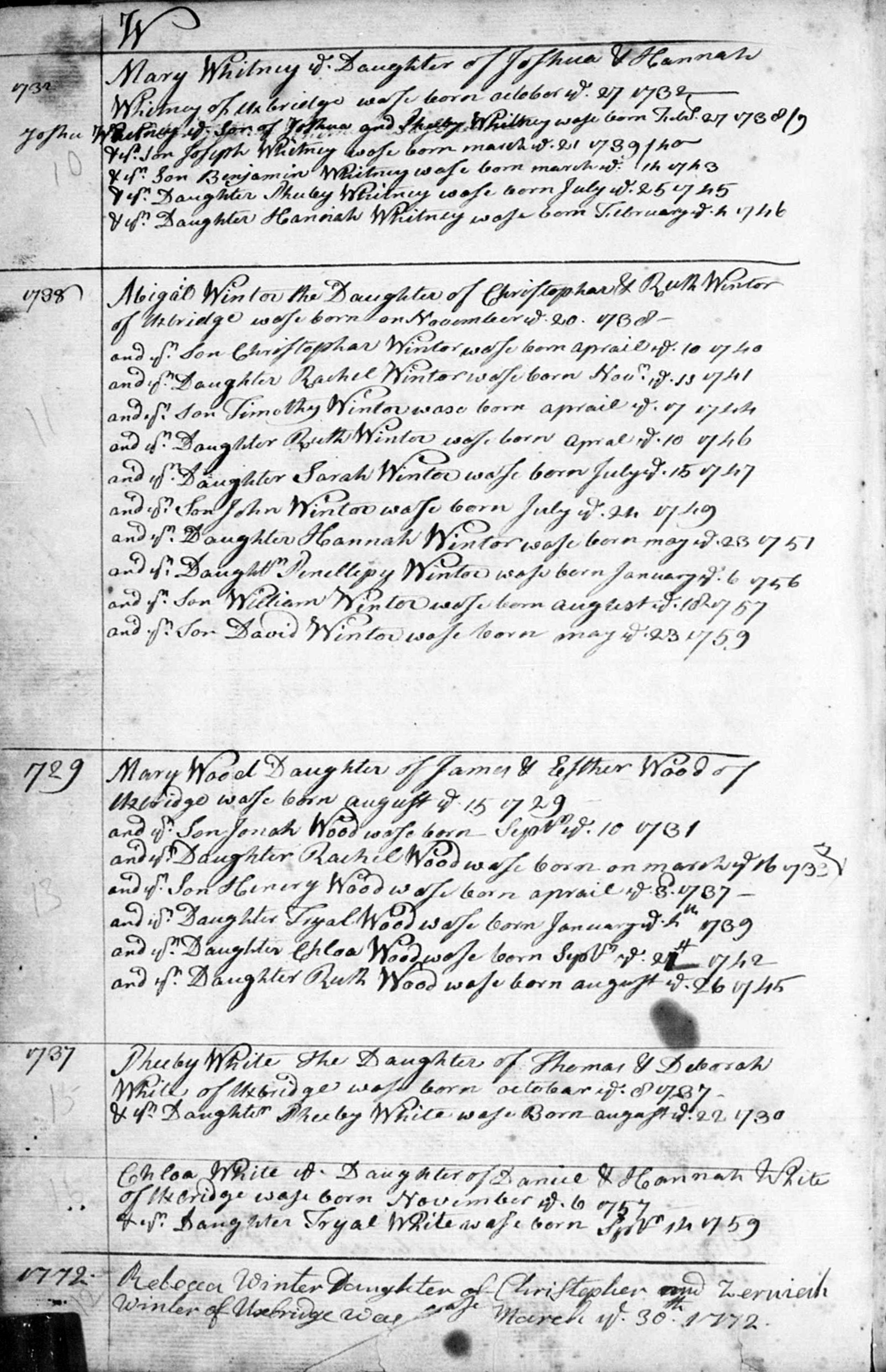
Rebecca Winter birth record.
The Continental Association was important to United States history because it was the first time all 13 Original Colonies agreed to implement and enforce a trade boycott against Britain.
The articles of the Continental Association imposed an immediate ban on British tea, and a ban beginning on December 1, 1774, on importing or consuming any goods from Britain, Ireland, and the British West Indies. It also threatened an export ban on any products from the Thirteen Colonies to Britain, Ireland, or the West Indies, to be enacted only if the Intolerable Acts were not repealed by September 10, 1775. The Articles stated that the export ban was being suspended until this date because of the "earnest desire we have not to injure our fellow-subjects in Great-Britain, Ireland, or the West-Indies." All American merchants were to direct their agents abroad to also comply with these restrictions, as would all ship owners. Additionally, article 2 placed a ban on all ships engaged in the slave trade.
The Association set forth policies by which the colonists would endure the scarcity of goods. Merchants were restricted from price gouging. Local committees of inspection were to be established in the Thirteen Colonies which would monitor compliance. Any individual observed to violate the pledges in the Articles would be condemned in print and ostracised in society "as the enemies of American liberty." Colonies would also cease all trade and dealings with any other colony that failed to comply with the bans.
The colonies also pledged that they would "encourage frugality, economy, and industry, and promote agriculture, arts and the manufactures of this country, especially that of wool; and will discountenance and discourage every species of extravagance and dissipation", such as gambling, stage plays, and other frivolous entertainment. It set forth specific instructions on frugal funeral observations, pledging that no one "will go into any further mourning-dress, than a black crepe or ribbon on the arm or hat, for gentlemen, and a black ribbon and necklace for ladies, and we will discontinue the giving of gloves and scarves at funerals."
Articles of Association, 1775
1775-04-29
On April 7, election of deputies to a New York Provincial Congress made at New Paltz by a "committee" of Patriots
Document that required the loyalty of New York citizens to the American cause during the Revolution (1775-1783).
General Association (Articles of Association) arrived in New Paltz and was signed. The Articles were prepared by the New York Provincial Congress and had been transmitted to the counties of New York to be signed in every town. The Articles formalized a boycott of British goods until Parliament repealed the Intolerable Acts. The Articles were signed in New Paltz at the home of Ann DuBois.
On April 19, the Battles of Lexington and Concord took place, beginning the American Revolution. The news of the battles reached New York on April 23rd.
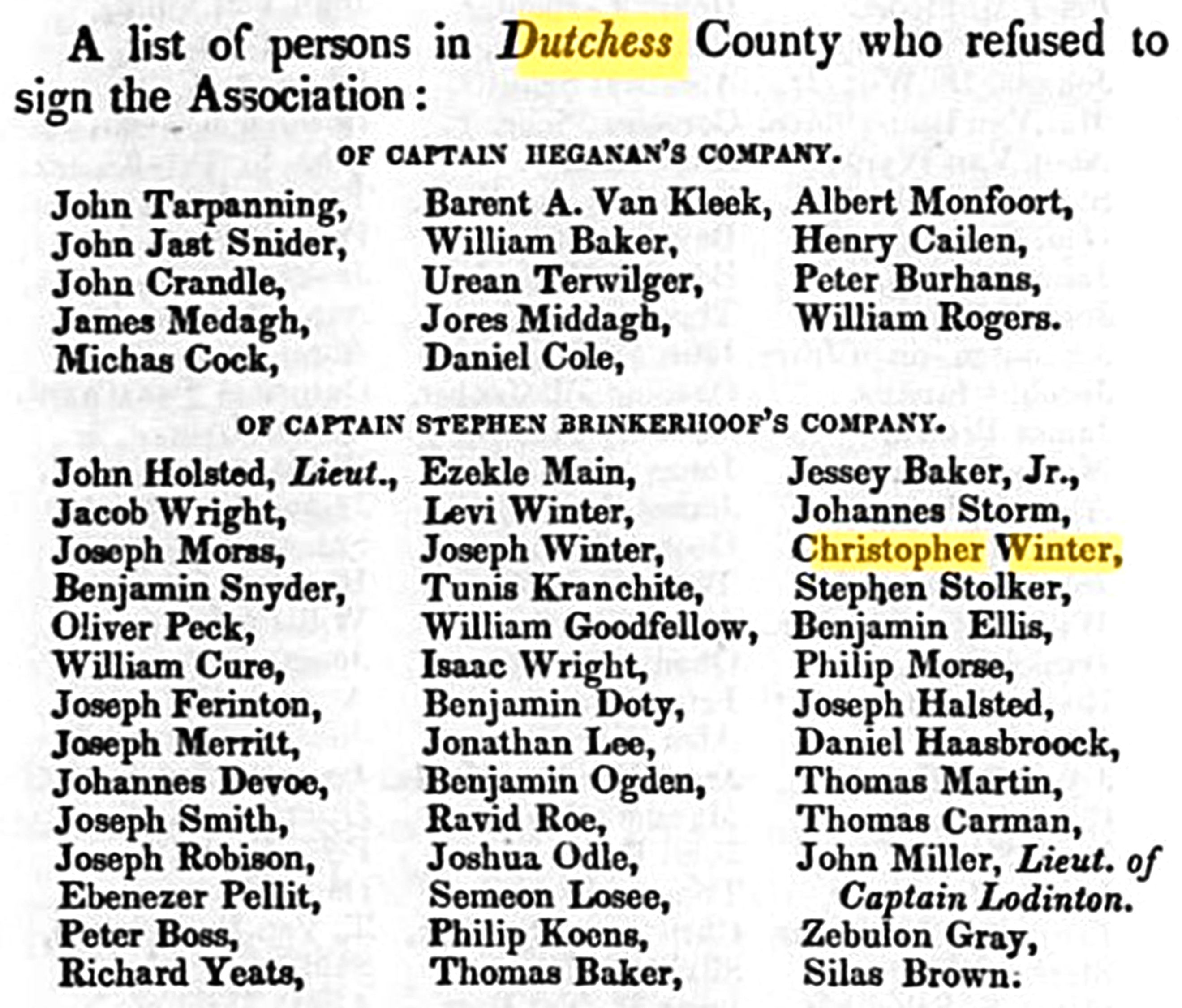
Christopher Winter is on a list of persons in Dutchess County who refused to sign the Association.
Mary "Polly" Winter was born April 11, 1777, in Fishkill, Dutchess Co., Province of New York.
9–13 May 1777 – Christopher Winter Jr. appears before NY Commission for Conspiracies, takes oath of allegiance, discharged (Fishkill/Fredericksburgh, NY). Internet Archive+1
1778 – Christopher Winter Jr. is a Private in Butler’s Rangers, Capt. John McDonell’s Company (payroll entries). Google Sites+1
James Winter was born November 26, 1780, in Vermont.
Lewis Winter was born June 1, 1782, in Salisbury, Litchfield Co., CT.
Paddick Vadoch Winter was born September 2, 1787, in Dutchess Co., NY. He arrived in Ontario, Canada, in 1797.
Christopher Winter Jr. served in Butler’s Rangers as a Loyalist from New York, lost his property there during the Revolutionary War, and became eligible for Crown land in Upper Canada as compensation.
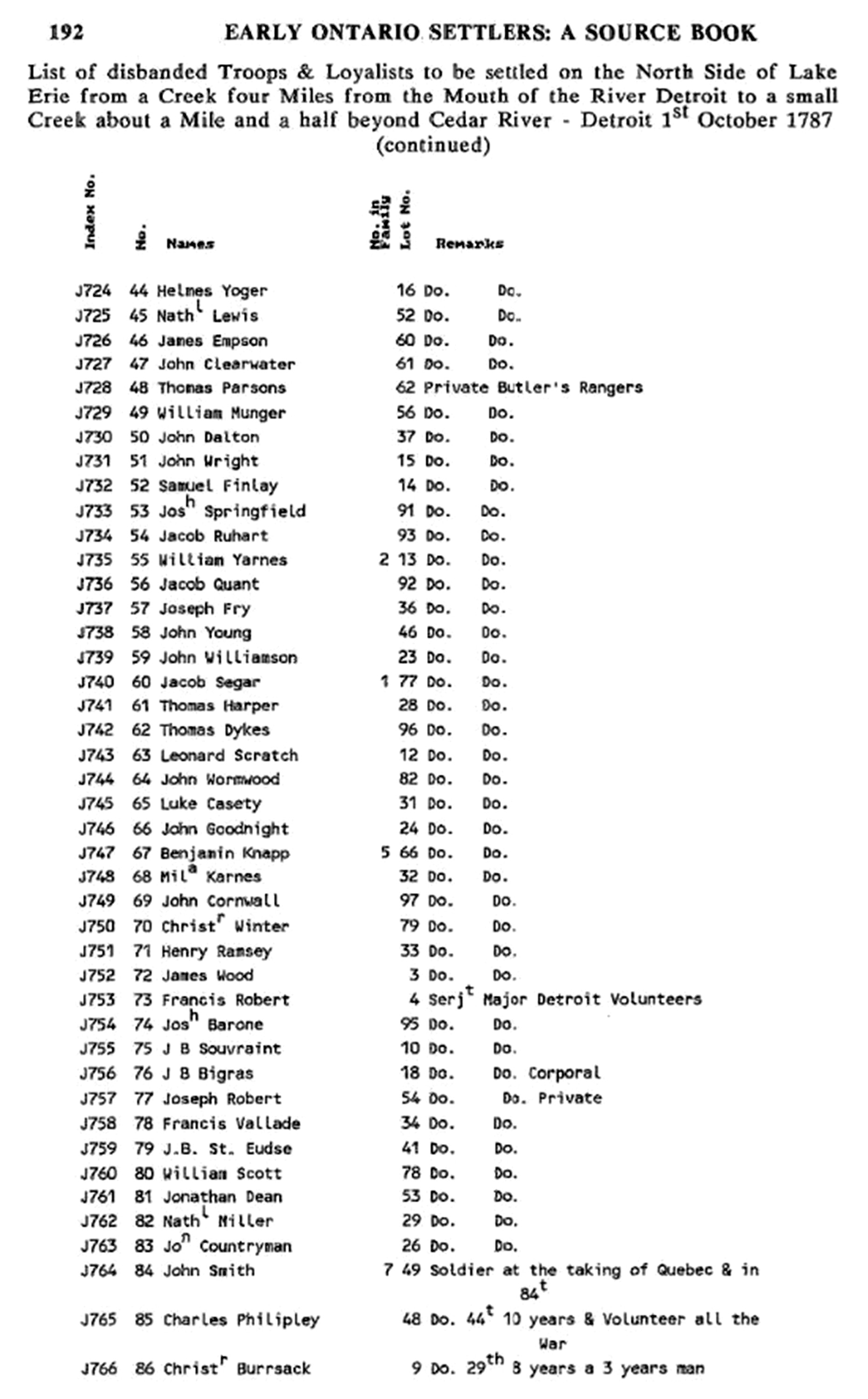
Christopher Winter, a Private in Butler's Loyalist Rangers, was granted land on October 1, 1787, for his military service.
The 1790 U. S. Census taken in 1790, shows Christopher Winter is living in Fishkill, Dutchess Co., NY. Living there are: 1 Male age 16 and over; 3 Males under age 16; and 3 Females.
The name Fishkill evolved from two Dutch words, “vis” (fish) and “kil” (stream or creek). Dutch immigrants, in the year 1714, searching for an acceptable location to settle and prosper, chose the area in and around the modern Village of Fishkill. Fishkill played an important role in the Revolutionary War when a vast military encampment was established one mile below the village to guard the mountain pass to the south.
In 1797, Christopher Winter Jr. was living in Haldimand Twp., Durham Co., Upper Canada.
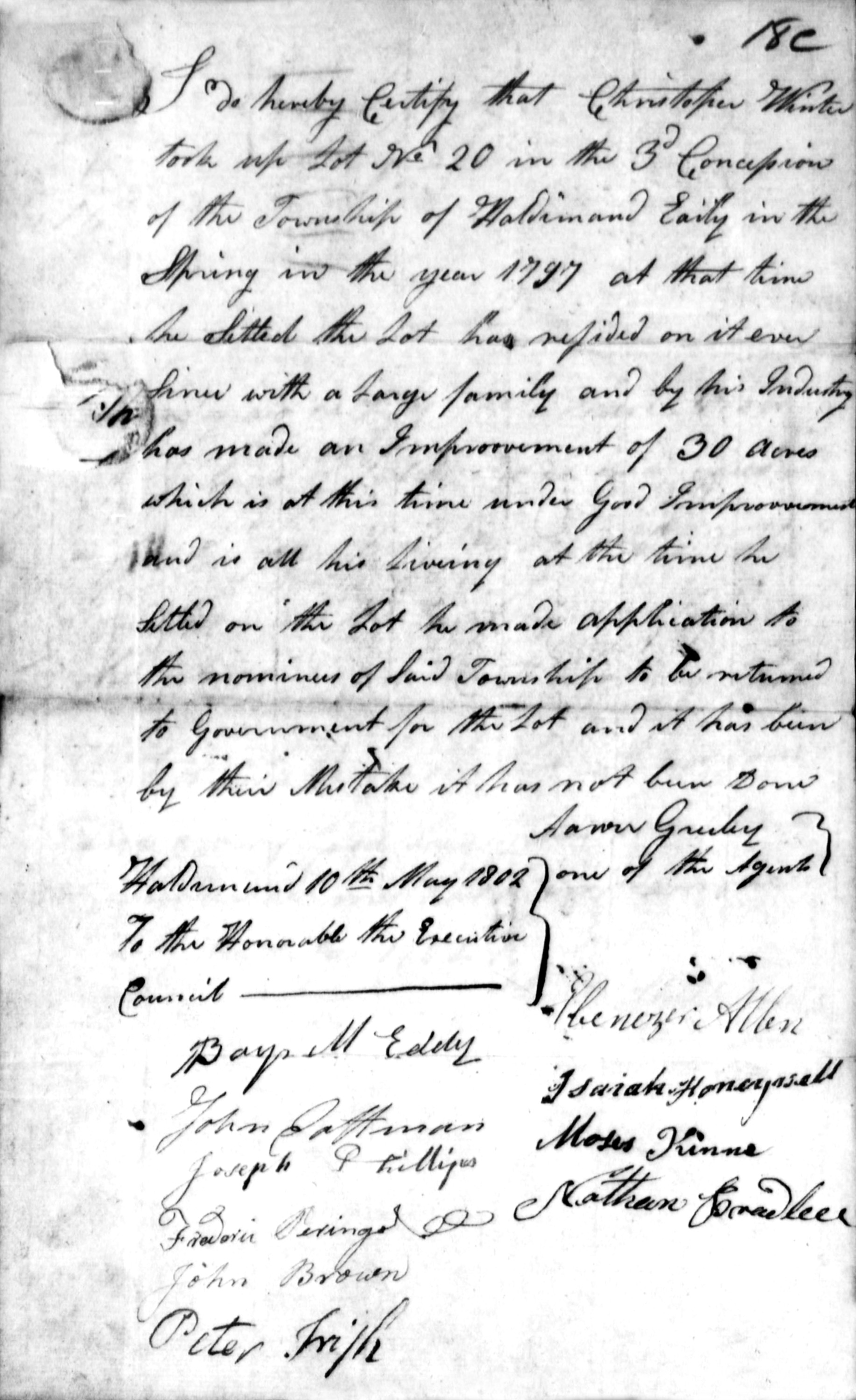
Christopher Winter took up Lot. No. 20 in the 3rd Concession in Haldimand Twp., early in the Spring of 1797. He then improved 30 acres of the lot.
The Canadian Statesman, Bowmanville, Ontario, Canada, February, 1995
BRAGG - Rowena Jane. At Marnwood Lifecare Centre on Saturday, February 11, 1995. Rowena Jane Bragg aged 104 years. Dear sister of the late Wesley, Martha, Elizabeth, Helena and Arthur. Daughter of the late Samuel Smale and Ellen Bragg. Dear aunt of Beatrice Campbell, Harold, Frank and Ted Hoar and great-aunt of Heather Griffin. Rested at the Northcutt Elliott Funeral Home from 10 a.m. Tuesday. Funeral service was held in the chapel 11 a.m. Tuesday. Cremation.
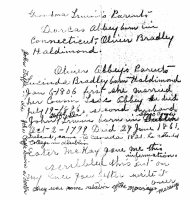
The above PDF contains the nine pages of recollections and thoughts compiled by Rowena Jane Bragg, who died Saturday, February 11, 1995, at Marnwood Lifecare Centre, Bowmanville, Ontario, Canada, at age 104. She was cremated. Never married. Some mentions are made of the Abbey lines. This information was forwarded by Eleanor Whyley, a descendant of Lucinda Bradley.
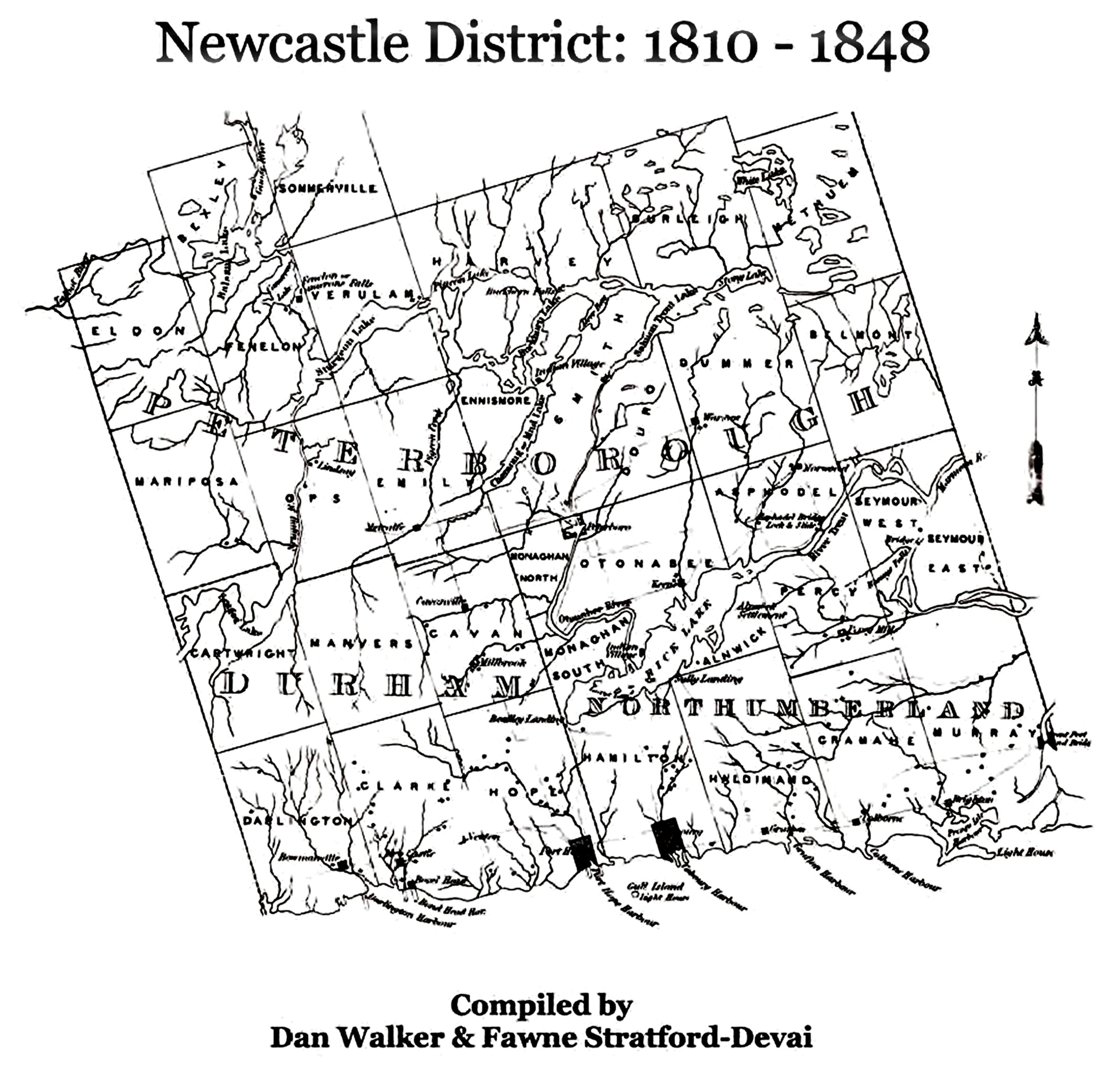
Christopher Winter then married (2) 1817, in Canada, to Anne Hawley.
Anne Hawley was born September 25, 1748, in New Milford, Litchfield Co., CT, and died November 14, 1846, in Colbourne, Cramahe Twp., Northhumberland Co., Ontario, Canada, at age 98. She is the daughter of Ephraim Hawley Sr. and Ann Chapman, and the twin of Ephraim Hawley Jr.
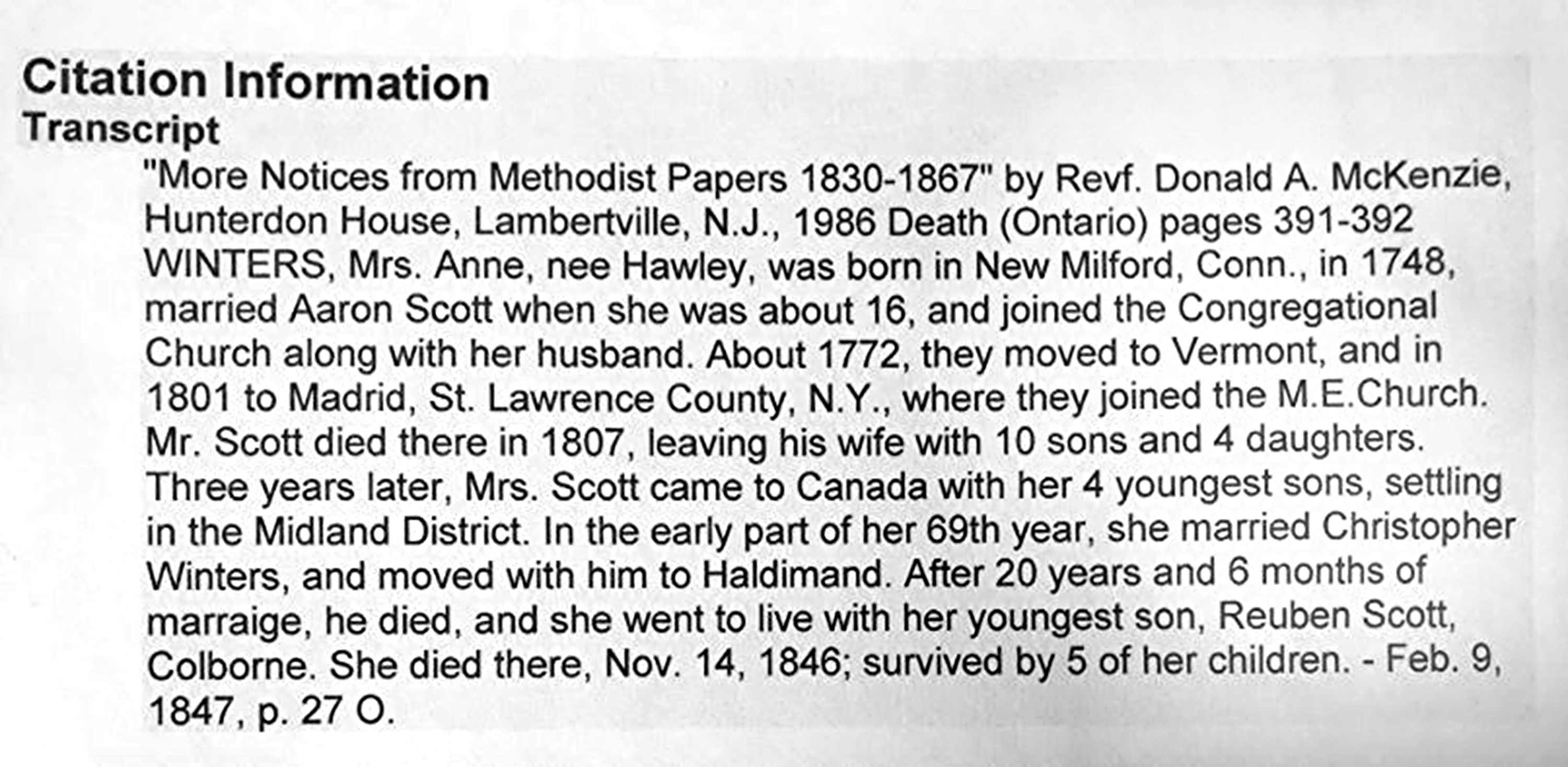
Anne Hawley biography.
Kay Koslan comments: Christopher Winter then married (2) 1817, in Canada, to Anne Hawley. 1837 fits into what I was telling you. The document I sent you on Anne Hawley says she was married to Christopher in the early part of her 69th yr. It mentions Christopher’s death being married 20 yr and 6 months. Since the year they were married, based on the yr she was married (1817) and when Christopher and her appeared in the 1817 Haldimand Census, then 20 years and 6 months would put it at 1837. We may be able to calculate closer if we find a marriage record for them.
In 1614, the Dutch under the command of Hendrick Christiaensen, built Fort Nassau (now Albany) the first Dutch settlement in North America and the first European settlement in
During the Revolutionary era a “Winter, Christopher” appears on the roster of Butler’s Rangers, a Loyalist provincial corps raised by John Butler and active on the New York–Canada frontier. The standard compiled roster (from A. H. Van Dusen’s 1900 article) lists him among the Rangers.sandycline.com+1
Separately, Upper Canada land-petition material and Sessional Papers describe a Christopher Winter of Butler’s Rangers making (or being cited in) land claims as a former Ranger, alongside other well-known members of that corps.Internet Archive+1
Modern researchers (including Dan Buchanan TreesByDan and Guylaine Pétrin) have wrestled with whether the Ranger and the Haldimand settler are the same man. The evidence is circumstantial but persuasive:
-
name is uncommon in this context
-
Loyalists from Butler’s Rangers were precisely the people being settled in the Niagara / Northumberland area
-
his sons’ and step-family timelines fit the Loyalist migration pattern (New York → Upper Canada)
So it’s reasonable, but not absolutely proved, to say:
Christopher Winter probably served in Butler’s Rangers as a Loyalist from New York, lost his property there during the war, and became eligible for Crown land in Upper Canada as compensation.
Ephraim Hawley III and Ann(e) Hawley were twins. Their brother Reuben, subject of the document photos borrowed here, seems to be the one that outshined the others. Ann Hawley named one of her sons Reuben, perhaps as a homage to her brother.
"More Notices from Methodist Papers 1830-1867" by Revf. Donald A. McKenzie, Hunterdon House, Lambertville, N.J., 1986
Death (Ontario) pages 391-392
Feb. 9, 1847, p. 27 O.
WINTERS, Mrs. Anne, nee Hawley, was born in New Milford, Conn., In 1748, married Aaron Scott when she was about 16, and joined the Congregational Church along with her husband. About 1772, they moved to Vermont, and in 1801 to Madrid, St. Lawrence County, N.Y., where they joined the M.E. Church. Mr. Scott died there in 1807, leaving his wife with 10 sons and 4 daughters. Three years later, Mrs. Scott came to Canada with her 4 youngest sons, settling in the Midland District. In the early part of her 69th year, she married Christopher Winters, and moved with him to Haldimand. After 20 years and 6 months of marriage, he died, and she went to live with her youngest son, Reuben Scott, Colborne. She died there, Nov. 14, 1846; survived by 5 of her children.
Anne Hawley biography.
Kay Koslan comments: Christopher Winter then married (2) 1817, in Canada, to Anne Hawley. 1837 fits into what I was telling you. The document I sent you on Anne Hawley says she was married to Christopher in the early part of her 69th yr. It mentions Christopher’s death being married 20 yr and 6 months. Since the year they were married, based on the yr she was married (1817) and when Christopher and her appeared in the 1817 Haldimand Census, then 20 years and 6 months would put it at 1837. We may be able to calculate closer if we find a marriage record for them.
Early Settlement and Development of Haldimand Township when the lakes roared.
In an effort to ascertain what land was being farmed and what was being held for speculation, Augustus Jones was asked to make a detailed report to the government on the location of each settler and what improvements had been made. On May 1, 1799, he found the following settlers in Haldimand Township: Ebenezer Allen (or Allan), George Baker, Gideon and Stephen Bordman (or Bowerman), Nathan Brady, Allen and John Brown, Asa Burnham, Joel Burns, John, John Jr. and William Carter, William Curtis, Asa Danforth, John Darling, Erasmus and Gaius Deane, Moses Doolittle, Bays Eddy, Joseph Farrington, Rozel Ferguson, Ferdinand Grout, Aaron Greeley, John Grover, Daniel and Stephen Hare, Arthur Hary, John Haveland, Thomas Hinman, Daniel Honeywell, Peter Irish, Charles Jones, Joseph Keeler, John Kelly, George McCalping, Nathaniel Michael, Patrick Moore, Mathias Morris, Rana Peering, Timothy Pettit, Joseph Philips, Joseph Richmond, Joseph Starks, Abnet Spencer, Benjamin, Isaac and Jincks Wait, Samuel Williams, Christopher Winter, and David and Peter Wyatt. This lengthy list of settlers grew quickly. By 1804 there were 356 settlers in Haldimand Township: 173 adults and 183 children. Haldimand was then the second most populous township in the Newcastle District after Hamilton Township to the west. On January 1, 1800, the townships of Murray, Cramahe, Haldimand, Hamilton, Alnwick, Percy, and Seymour and the Peninsula of Newcastle were formed into Northumberland County. Northumberland County administration began in July of that year when David McGregor Rogers of Haldimand became Registrar for the county. Prior to his appointment, all land registrations for the region were made in Newark (Niagara-on-the-Lake). Haldimand's pioneers now had a convenient location in their own area to register title to their property and many now took the opportunity to do so. Although the committee did not mention the origin of the name they had chosen, Grafton appears to have taken its name from a town in Massachusetts from which John Grover had emigrated. Grafton, Massachusetts had been named in honour of the Duke of Grafton, a grandson of King Charles II.
Grafton
The hamlet of Grafton, located on Lots 22, 23 and 24 in Concessions A & I, was known by various names, including Grover's Tavern and Haldimand Post Office, until a Wednesday in March 1832. That day, a few civic minded residents got together and formed a committee for the purpose of formally naming the settlement. In a letter to the Cobourg Star dated March 22, 1832, and signed by John Taylor, James G. Rogers and Eliakim Barnum, the new name was announced:
Sir: The improved and flourishing state of the Township of Haldimand has led to the rapid formation of a village about the place which was formerly known as "Grover's Tavern" and in conformity to the usage, several gentlemen of the neighbourhood met by appointment at that place on Wednesday last for the purpose of giving it a name. After considerable discussion, that of Grafton was unanimously agreed upon, as will appear by the resolution herewith sent you.
The hamlet had been settled for quite some time prior to its naming. It may have begun as a convenient half-way stop along the Danforth Road that once led from York (Toronto) to Kingston. Due to its strategic location, many inns were built in the area. An early inn was run by the Spalding family. As Loyalists, Zebulon and William Spalding were granted land in Haldimand Township in 1792. On their land, they soon built a home and an inn. Spalding's Inn continued in use until at least 1820, when it was converted into a brewery. In 1817 a traveller named Charles Fothergill passed through Grafton and stayed at an inn that became a local landmark. He described his stay at Grover's Inn as follows:
Found Grover a one-eyed dark complexioned & very shabby & suspicious looking fellow - & drunk withal & very loquacious & very consequential in his own eyes. Settled here 15 years ago when there was not a soul within many miles of him. - Showed me a small library of religious books in a cupboard In my bedroom with an air of great triumph - glad to see it tho' doubtful as to the benefit he derived from their perusal for I did not like his manners nor the continual surprize he expressed at my travelling alone in such a country, & his frequent interrogatory whether I was not afraid of being robbed & murdered - in faith I might be both & no one be the wiser - as he lifted my portmanteau into my bedroom, remarked on its weight saying it must be full of money - I did not like his manner of handling & pointing my double-barrelled gun - which was dubious - Bed room however was very comfortable with a cheerful blazing fire on the hearth of maple wood - I fastened the door & committed myself to repose & to the protection of the Divine Deity whom I have so frequently & so heinously offended. The next day, Fothergill noted a distinct change in Grover's attitude and concluded that, sober he was a much superior man.
Edward H. Pepper took over Grover's Tavern before 1832 and offered it for sale. The following advertisement appeared in the Cobourg Star on July 11 of that year:
For sale - all that excellent and well known tavern stand in the Village of Grafton with outhouses, sheds, etc. and 3/ 4 acre of land, known for many years by the name of Grover's Tavern and now in the occupation of Mr. Pepper.
A notice dated November 30, 1833, in the same newspaper, announced that John McNulty and B. Murray, tailors, had removed to Grover's Old Stand, formerly occupied by Pepper's where they would be ready to wait on those who called. By 1835 the old Grover's Inn had become Arkland's Tavern. Until the building of the town hall on the east side of the inn in 1859, Arkland's was the regular meeting place for the township council, the district court and for numerous local organizations. It was operated by John Arkland who was married to Belinda Ewing, a sister of Benjamin Ewing and Hannah Barnum. In late 1842 or early in 1843, Arkland's Tavern was sold. The new owner was William Patterson, a settler who had come to Haldimand in 1822. In February 1843 he informed customers of his new business through the following advertisement in the Cobourg Star.
In 1836 the Grafton Harbour Company was formed. The directors of this company were Richard Hare, John Grover, Malcolm McNeil, J. Warren, John Clark, Thomas M. Spalding, James G. Rogers, Edward H. Pepper, Thomas Spencer, Donald Hare, John Spencer, Roderick McKenzie, William Carroll and Jacob Van Alstine.
Societies
Masonic Lodge of Grafton
Soldiers from British regiments who fought in the Seven Years War introduced freemasonry to Canada and the organization subsequently accepted civilians as members. St. John's Lodge #19 of the Township of Haldimand was one of the first and longest surviving lodges of the district. The original warrant was dated October 4, 1801. Worshipful Brother Aaron Greeley was named Worshipful Master, Brother John Grover, Senior Warden, and Brother Chester Eddy, Junior Warden. In 1806 a revival took place with the Craftsmen of the Township of Cramahe joining the Brethren of Haldimand and a new warrant was issued. By-laws for this Lodge were submitted on April 4, 1811. Meetings were generally held in Grover's Inn, Grafton, although some meetings were held at the home of Caleb Mallory, Brookside. From 1818 to 1819, the Lodge met regularly at the home of John Kelly on Kelly's Hill at Brookside. Meetings were held regularly from 1822 to 1826. After this records were few until 1844, when the Lodge next appeared on the roll of the Provincial Grand Lodge. The Masonic Lodge met in the upper storey of the Halfway House.
Northumberland Agricultural Society
A meeting was held at John Grover's Inn on May 18, 1829, to form the Northumberland Agricultural Society. At this meeting Benjamin Whitney was elected president, Capt. Spilsbury, R.N. and Charles Powers, vice-presidents, Joseph A. Keeler, treasurer and John Steele, secretary. The directors were: William Falkner, Henry Ruttan, Zaccheus Burnh am, John Burnham, Archibald MacDonald, James J. Bethune, John Fraser, Charles Rubidge, Benjamin Cumming, Jason Lyons, M.P. Benjamin Ewing, M.P. Shelden Hawley, John Grover, John Kelly, Ephraim Doolittle, Ozen Strong, Jason D. Goslee, David Brodie, Levi Loomis and Isaac Proctor. The directors each contributed three dollars toward prizes and other subscriptions were solicited. The first cattle show of the society was held in the public square of the village of Colborne on October 19, 1829, and prizes in the amount of $77 were paid.
In 1830 the society offered premiums for the best managed farms in the County. Sisson Waite of Haldimand was one of five winners out of 12 entries. Over the years most subscribers were reimbursed through awards. Government assistance was given in 1831 when legislation was passed to encourage the establishment of agricultural societies. It specified that when £50 was raised in a district, the government would, on petition, give £100 to be divided among all such societies within that district.
On November 13, 1831, a letter addressed to the association signed by "T.S." chastised members for " making a flourish in the newspapers about cattle shows, premiums, great dinners, long speeches" and urged the society to produce tracts to educate farmers, many of whom were very inexperienced. He suggested that experienced farmers should present a topic on rural affairs to the monthly meeting and, if found worthy, it should be published.
The society seems to have disbanded for a few years, and then on December 21, 1836, an announcement appeared in the Cobourg Star inviting "Gentlemen Farmers and other interested in agriculture to attend a meeting at Arkland 's Tavern, Grafton." At this meeting George Manners was president and Donald McTavish, secretary. Among those who attended were: Messrs. Mason, Steele, Barnum, Cooke, Warren, Mellis, Gillard, McNeil, Ewing, Grover, Rogers, Hammond, Innes, Jack, Hare, Taylor, MacDonald and Halliday.
THE HONEYWELL FAMILY
by Vanessa Warner Bacola
The Honeywell family in Haldimand Township has all but died out, but they were among the founding families of the township. The progenitor of this family was Isaiah Honeywell, who was born on October 15, 1752, in Duchess County, New York. He lived in Lunesboro, Massachusetts and Rutland, Vermont. The family is of Welsh origin and the name Rice, which has been Anglicized from the Welsh name Rhy, appear frequently through the generations. Research has shown that Isaiah came to Haldimand on April 17, 1797, and received a crown grant of Lot 33, Concession III comprising 200 acres. After arriving in Canada, Isaiah married Betsy Cartwright, a widow with several sons. To this union were born three sons, Amos (1799-1884), Rice (1804-1 98) and Daniel (1805-?). Isaiah and Betsy lived in Haldimand and little is known of their years in the community. It is certain that clearing land and farming was a large part of their day-to-day existence. Although no tombstones have been located, it is assumed that both are buried at Academy Hill Cemetery which is near by burial ground to their farm. Amos married Parmelia Allen and they had eight children. The couple began their married life on Isaiah's property, and eventually prospered sufficiently to purchase Lot 20, Concession IV in Haldimand. When they died in 1 84 and 1889 respectively, they were buried at Eddystone cemetery. Rice (1827-1901), a son of Amos, married Deborah Winter (1827- 1920). They owned part of Lot 22 Concession IV, a property consisting of 80 acres, and then purchased a further 80 acre on Lot 15, Concession VI. Deborah is buried at Academy Hill cemetery near to her infant so n who died at 14 months, while Rice is buried in Centreton.
Charles (1 29-1 96), another of Amos's on, married Ellen Pender in 1850. They settled first on Lot 22, Conces ion I Il moving to Lot 22, Conces ion IV, which he bought from Amo. Later they owned Lots 6 and 7 in Concession VII where they lived until Ellen's death. Charles is buried at Centreton, but Ellen, who was a Roman Catholic is presumed buried at Burnley, for which no record exists.
Another brother, Smith, farmed and raised a family on his grandfather's (Isaiah's) farm on Lot 22, Concession III, and also farmed on his father's (Amos's) property on Lot 20, Concession IV.
THE BRADLEY BRYSON FAMILY
by Bill Bryson
As a young man of about 20, Nathan Bradley left the United States following the War of Independence. He settled with his wife, Elizabeth Harden, near present-day Eddystone. Nathan and Elizabeth had 12 children: eight sons and four daughters. Four of these children are buried in Eddystone cemetery. They are: William, and his wife Deborah Tripp; Polly, and her husband Jonathan Russ; Sylvanus, and his wife Sally Tucker; and Hiram. Their eldest child, Lucina, married Daniel Massey. Their second child, Abraham, married Ruth Tucker. This union produced nine children, four of whom are buried in Eddystone. One of their sons, Charles Sydenham, married Hanna Hubble and they had three children, Lock Amsdon, Alma and Charles Arthur. Lock and Alma married sister and brother Jennie and Matthew Floyd. In 1894 Lock, Alma and their families moved west to Manitoba. In 1994 Lock and Jennie's great-grandson, Larry McDougall, bought a farm on the Centreton/Castleton road, east of Centreton, next to Bradley Hollow road. In purchasing this farm, Larry had no idea that this was where his ancestors had come from. Charles Arthur Bradley was 14 years old when his brother and sister went west. He stayed behind on his father's farm and as a young man married Florence Joice. In the 1920s Charles and Florence ran the Haldimand Municipal telephone exchange in the house adjacent to the Grafton hotel. At this time Charles helped to build a dam across the creek beside the house to create a pond for a skating rink for the young (and not so young) people of the village. It was this frozen pond that a decade later would claim the life of their grandson Jimmy. Their daughter, Dorita, married Harvey Bryson. Harvey was born in Kendal, Ontario on September 14, 1898, and apprenticed as an auto mechanic with General Motors in Oshawa. He moved to Grafton in the early 1920s and worked for Percy Roberts who had a garage on the south side of Highway #2 at the foot of Aird Street. During this time he also boarded with the Roberts. Harvey and Dorita Bradley were married on December 3, 1927, and lived near the public school while their house was being built. Harvey bought a bit off land from Percy Roberts for $100. He then bought an old hired hand's house on the Hare farm north of Hare's school for $150. This house was already 100 years old at the time. He dismantled the house, trucked it to the village and used the material obtained to build his house. His father Sam, who was a barn builder, came down from Kendal to help him.
FAMILIES
Young Jimmy Bryson was born to Harvey and Dorita on August 13, 1929. A second child, Jean, was born on February 20, 1932. On January 12, 1934, Jimmy spent the afternoon with a friend a few doors west of the Grafton Hotel. Leaving for home around five o'clock, he decided to take a short cut up behind the hotel, turning in at the snow-covered skating pond by the highway. Unaware, as he approached the point where the creek flowed into the pond, that the moving water would keep the ice thinner than that further out, Jimmy broke through the ice, was dragged under by the current and drowned. The pond was drained to recover his little body and has remained dry ever since. The Brysons had seven children who found careers away from Haldimand but two granddaughters, Linda Sturzenegger and Joyce Turk make their home in Grafton. In the spring of 1956 Rolly Morrison, Children's Aid worker, had three young brothers to place in three good homes for three months while their mother recuperated from major surgery. Not knowing the village that well he came to Dorita Bryson and asked if she could recommend who he should approach. By the time he left our house arrangements had been made for all three brothers to spend these months with the Bryson s, who still had three of their own sons at home.
B. 10 October 1820 – Sale by Christopher Winter (Winter → Massey)
Citation (Full):
Northumberland County, Ontario, Haldimand Township,
Abstract Index to Deeds,
Concession 3, Lot 24, entry for
Bargain & Sale No. 803 (Winter to Massey, 10 October 1820); Land
Registry Office Northumberland, Cobourg, Ontario; digital images, FamilySearch
microfilm of Abstract Index books.
Short form:
Haldimand Twp. Abstract Index, C3 L24, B&S 803 (1820).
Note:
This entry shows Christopher selling
50 acres, described as the
east half of the west half of the same Lot 24, to
Jonathan Massey.
C. ca. 1822 – Will of Christopher Winter registered in land records
(Instrument number varies by register; treated here as a registered will on Lot 24, Concession 3.)
Citation (Full):
Northumberland County, Ontario, Haldimand Township,
Abstract Index to Deeds,
Concession 3, Lot 24, entry for instrument recording the
probated will of Christopher Winter,
dated c. 1822, disposing of land to his heirs; Land Registry Office
Northumberland, Cobourg, Ontario; digital images, FamilySearch microfilm.
Short form:
Haldimand Twp. Abstract Index, C3 L24, registered will of Christopher Winter
(c.1822).
Note:
In Ontario registry practice, wills that transfer title to heirs were registered
as instruments; this entry accounts for his death and land distribution among
his children.
D. Earlier occupation — 1797 Settler List (non-registry but land-related)
Citation (Full):
Upper Canada, 1797 List of Settlers,
Haldimand Township, entry for “Christopher Winter”; derived from Upper Canada
Land Petitions, published transcription; original petitions, RG 1 L 3, Library
and Archives Canada.
Short form:
1797 Haldimand settlers list, “Christopher Winter.”
Note:
This is not a deed, but it places Christopher Winter in
Concession 3, likely Lot 20,
by 1797, nearly two decades
before the registered transactions.
Parsing Christopher Winter’s Will (Land Bequests)
The will is referenced in land-record discussions and appears as a registered conveyance. Enough text survives in transcriptions to reconstruct the land-disposition pattern.
Summary of the Will (as preserved in land records)
Christopher Winter’s will, dated about 1822, includes the clause:
“I give to my son Paddick Winter ninety acres of land …”
(Other clauses distribute moveable property and support obligations among children.)
From the land-registry context and acreage, this ninety acres is almost certainly the remainder of Lot 24, Concession 3 after his 1820 sale of 50 acres.
How the land was divided among the children:
1. Paddick Winter (son)
-
Receives: “ninety acres of land”
-
Meaning:
After selling 50 acres in 1820, Christopher retained roughly 100 acres − 50 acres = 50 acres if the original tract was only 100 acres.
BUT Ontario lots in Haldimand were typically 200-acre Crown lots.
Therefore, the surviving “ninety acres” given to Paddick almost certainly represents the remainder of the original lot, accounting for subdivisions and earlier unregistered portions. -
Registry impact:
The abstract index should show a transfer to Paddick following the registration of Christopher’s will.
2. Other children (heirs named in the will)
Although the surviving transcriptions do not give all names and acreages, the will does dispose of real property to multiple heirs and personal property to several others. Based on the abstract traditions and the written commentary:
-
James Winter and
-
—other sons/daughters (names vary by source)
are mentioned, but the sole direct land bequest explicitly known from current evidence is:
Paddick Winter — 90 acres (Lot 24, Concession 3).
Other children appear to receive personal property or, in some cases, beneficial interests that do not show up in land records.
3. The will as an instrument of title transfer
Because Ontario practice required heirs to register a will in order to perfect title, the registry-office entry is critical for:
-
Establishing Christopher Winter’s date of death (before registration)
-
Demonstrating which heir received which parcel
-
Providing the chain-of-title for Lot 24, Concession 3
Key Events for Christopher’s record:
-
28 Jan 1737/8 – parents marry in Uxbridge, MA (link for sourcing). Internet Archive+1
-
10 Apr 1740 – birth at Uxbridge, MA (family reconstructions from vital records). Geni+1
-
9–13 May 1777 – appears before NY Commission for Conspiracies, takes oath of allegiance, discharged (Fishkill/Fredericksburgh, NY). Internet Archive+1
-
1778 – Private in Butler’s Rangers, Capt. John McDonell’s Company (payroll entries). Google Sites+1
-
1797 – listed as settler “Christopher Winter, 20, 3rd” in Haldimand Township (Lot 20, Concession 3). RootsWeb+1
-
1803–1825 – repeatedly enumerated in Haldimand Township censuses. Trees By Dan+1
-
27 Aug 1818 – buys 100 acres, N part of Lot 24 Concession 3 from Ebenezer Allen, B&S 730. Trees By Dan+1
-
10 Oct 1820 – sells 50 acres (E½ of W½) of same lot to Jonathan Massey, B&S 803. Trees By Dan+1
-
c. 1822–1839 – will written and later registered, leaving 90 acres in Haldimand to son Paddick. Leigh Larson+2Leigh Larson+2
-
1837 – death in Haldimand Township; will registered 1839. L